
ALWAYS CONSULT YOUR INVESTMENT PROFESSIONAL BEFORE MAKING ANY INVESTMENT DECISION

May 15, 2026 | The Taiwan Risk Investors Forget

Hilliard MacBeth


China’s long history of interest in Taiwan stems from its view that the island is part of a single Chinese nation, a belief rooted in centuries of cultural and political ties. That perspective has shaped Beijing’s policies since the mid twentieth century and continues to influence every diplomatic exchange today. It is against this backdrop that the recent summit between the United States and China unfolded, with President Trump emphasizing that the relationship between the two countries has become one of the most consequential in world history. While he often speaks in sweeping terms, this particular point carries weight. Stability between these two superpowers is essential to global order, and nowhere is that more evident than in the discussion surrounding Taiwan.
For investors, Taiwan is not simply a geopolitical flashpoint. It is the center of gravity for the modern technology economy. The island is home to Taiwan Semiconductor Manufacturing Co., better known as TSMC, the company responsible for producing an estimated 90 percent of the world’s most advanced chips. These chips power the devices and data centers that define the current era of artificial intelligence. Apple and Nvidia, worth a combined ten trillion dollars, account for nearly 40 percent of TSMC’s sales. Other major chip makers, including Intel, AMD, Broadcom, and Qualcomm, add another three and a half trillion in market value tied directly to TSMC’s output. The customers of those chip companies, such as Microsoft, Amazon, Alphabet, Meta, and Oracle, represent roughly thirteen trillion more. When you add the equipment suppliers that enable TSMC’s manufacturing, including ASML, Applied Materials, and Lam Research, plus private companies like SpaceX, OpenAI, and Anthropic, the total value of firms connected to Taiwan’s semiconductor ecosystem reaches about thirty trillion dollars. That is roughly twenty three percent of the projected global economy in 2026, a figure that illustrates how deeply the world’s markets depend on the island.
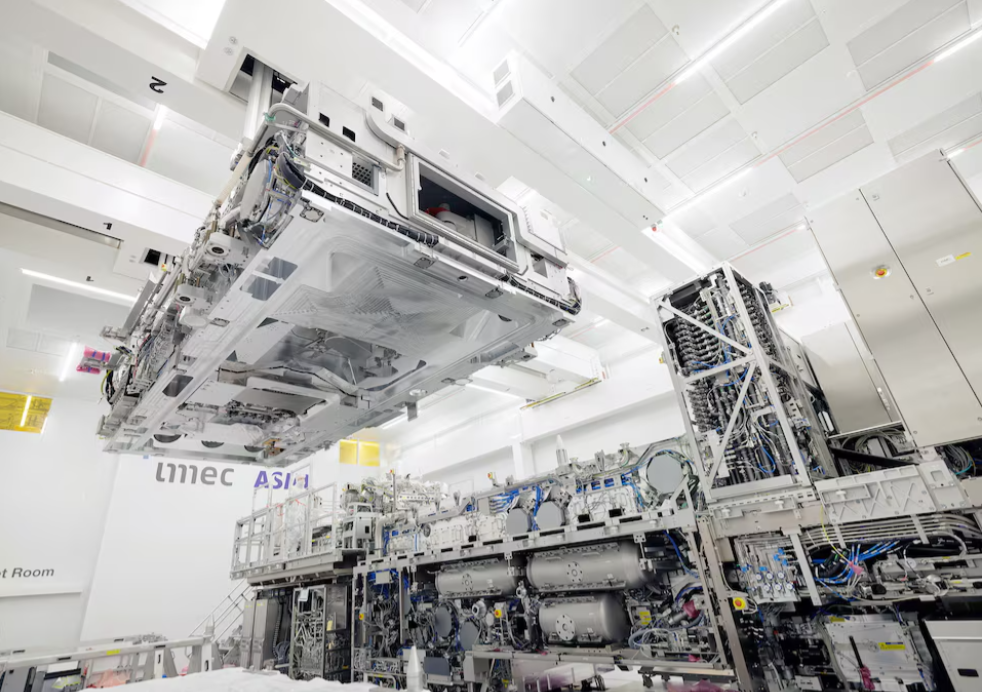
A high numerical aperture extreme ultraviolet lithography tool by ASML. The next-generation EUV lithography machine designed to print smaller, faster, and more energy-efficient chip features for advanced AI and computing. One unit costs over US$350M. Source: ASML
This interconnectedness is why the comments I heard from former Lieutenant General Andrew Leslie in September 2025 have stayed with me. Speaking to Richardson Wealth advisors, he suggested that China would not need to launch a full scale invasion to exert pressure. A naval blockade could be enough. Taiwan’s economy is heavily dependent on imports, and natural gas is its most vulnerable point. Supplies would last only ten to eleven days. Even a short disruption would send shockwaves through supply chains, corporate earnings, and investor confidence. The global market is not built to absorb a sudden halt in semiconductor production.
The takeaway is not to assume the worst but to understand the concentration risk embedded in today’s AI driven rally. A significant portion of the world’s market capitalization is tied to a single geographic location. Diversification across sectors and regions remains one of the most effective tools for managing uncertainty. Policymakers and executives are working to expand chip manufacturing capacity outside Taiwan, but progress is slow and the industry structure remains unchanged. Until that shifts, Taiwan will continue to represent a single point of failure in a world that depends on uninterrupted technological advancement. Investors who appreciate these stakes can position themselves more thoughtfully for the years ahead.
Fraser Betkowski
The opinions expressed in this report are the opinions of the author and readers should not assume they reflect the opinions or recommendations of Richardson Wealth Limited or its affiliates. Richardson Wealth Limited is a subsidiary of iA Financial Corporation Inc. and is not affiliated with James Richardson & Sons, Limited. Richardson Wealth is a trade-mark of James Richardson & Sons, Limited and Richardson Wealth Limited is a licensed user of the mark. Richardson Wealth Limited, Member Canadian Investor Protection Fund.
STAY INFORMED! Receive our Weekly Recap of thought provoking articles, podcasts, and radio delivered to your inbox for FREE! Sign up here for the HoweStreet.com Weekly Recap.
Hilliard MacBeth May 15th, 2026
Posted In: Hilliard's Weekend Notebook