

ALWAYS CONSULT YOUR INVESTMENT PROFESSIONAL BEFORE MAKING ANY INVESTMENT DECISION

May 1, 2026 | Party Like It’s… Well, You Know


Hilliard MacBeth


A number of clients have been asking the same question lately: What gives? Why does the stock market keep rising? It’s a fair question. The S&P 500 continues to levitate, seemingly indifferent to geopolitical tension, sticky inflation, and the growing possibility of a U.S. recession. And while it’s generally considered bad form in finance to invoke 1999—rather like saying “Macbeth” in a theatre—it’s getting harder not to think about the dot‑com era when looking at today’s AI‑driven enthusiasm.
To be clear, comparisons to 1999 can be an exaggeration. Markets can be expensive without being in a once‑in‑a‑century bubble. But the truth is that very few periods in market history look anything like the late 1990s. The Great Crash of 1929 is the only other episode that reliably shows up in the same statistical neighborhood.
Still, the echoes are getting louder. Then as now, valuations were already stretched after a long expansion. A new technology—first the internet, now AI—captured imaginations and capital in equal measure. And both periods featured a moment of existential dread: Long‑Term Capital Management’s near‑collapse in 1998 back then; the U.S.–Iran conflict this spring, which briefly raised fears of a much broader crisis, today.
One data point that keeps coming up in conversations is the cyclically adjusted price‑earnings ratio, or CAPE, popularized by Dr. Robert Shiller. CAPE smooths earnings over 10 years to give a more stable view of valuation. The day before markets hit new highs on April 30, the CAPE sat around 40.5. For context, the peak at the end of 1999 was 44.19. That doesn’t mean we’re destined to repeat history, but it does show how far valuations have climbed.
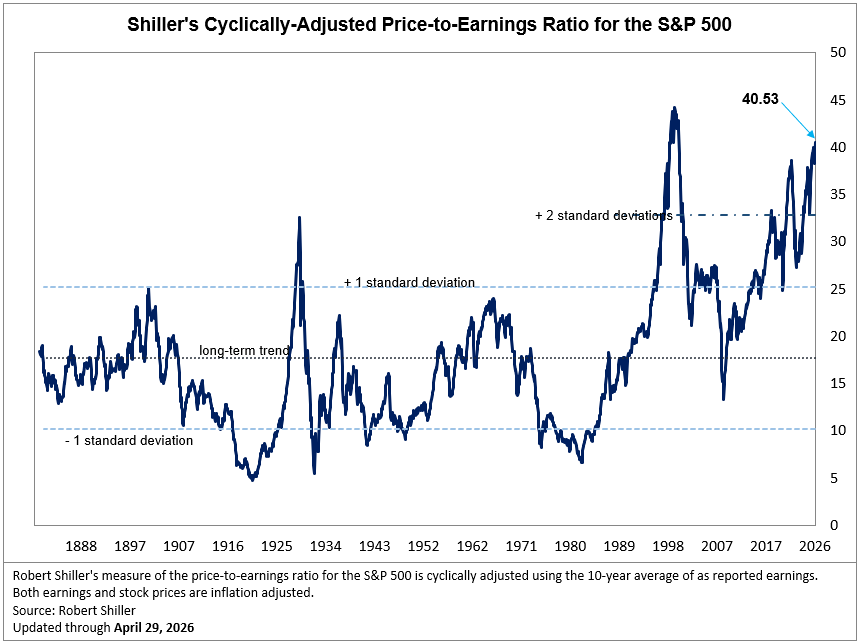
So what would the catalyst be this time? In 1998, LTCM nearly took down the financial system. Today, a U.S. recession is plausible, especially if inflation reaccelerates on the heels of Middle East tensions. Some analysts have speculated about a more hawkish Federal Reserve—particularly if inflation proves stubborn and policymakers feel compelled to tighten into weakness. Whatever the trigger is, it hasn’t arrived yet.
Meanwhile, markets are behaving as though the path of least resistance is still up. Semiconductor stocks have surged in a way reminiscent of the SOX’s explosive run after Greenspan’s surprise rate cut in late 1998. Sentiment has snapped back sharply; bullish investors now outnumber bears for the first time in months. And just as theglobe.com’s infamous 900% first‑hour pop helped push the dot‑com bubble into its final phase, this year’s anticipated IPOs—SpaceX, OpenAI, and others—may test the market’s appetite for risk.
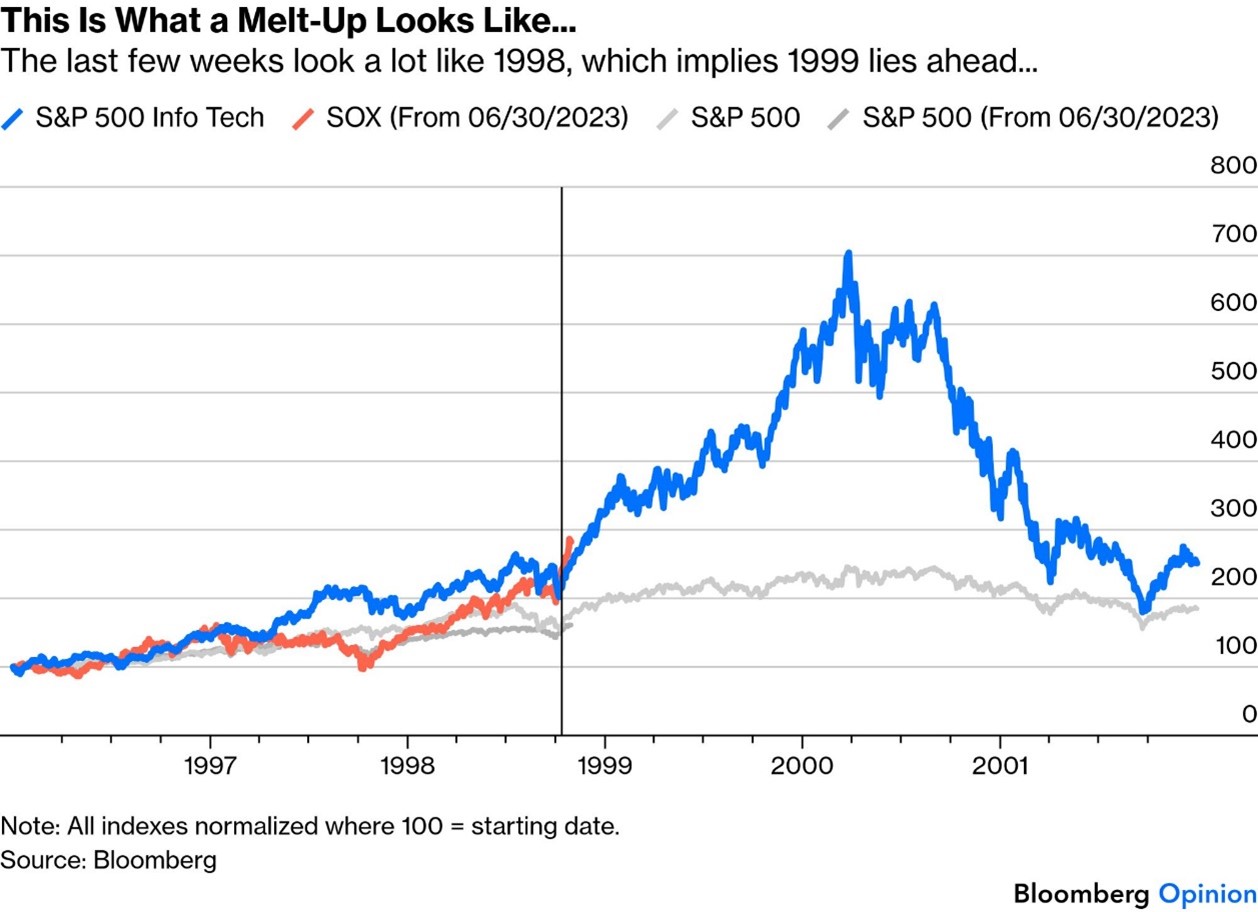
None of this proves a melt‑up is inevitable. The sample size of true bubbles is tiny. But history suggests that once momentum takes hold, it can feed on itself. That’s the uncomfortable truth for investors: while the music is playing, it’s hard to leave the dance floor.
Fraser Betkowski
The opinions expressed in this report are the opinions of the author and readers should not assume they reflect the opinions or recommendations of Richardson Wealth Limited or its affiliates. Richardson Wealth Limited is a subsidiary of iA Financial Corporation Inc. and is not affiliated with James Richardson & Sons, Limited. Richardson Wealth is a trade-mark of James Richardson & Sons, Limited and Richardson Wealth Limited is a licensed user of the mark. Richardson Wealth Limited, Member Canadian Investor Protection Fund.
STAY INFORMED! Receive our Weekly Recap of thought provoking articles, podcasts, and radio delivered to your inbox for FREE! Sign up here for the HoweStreet.com Weekly Recap.
Hilliard MacBeth May 1st, 2026
Posted In: Hilliard's Weekend Notebook