

ALWAYS CONSULT YOUR INVESTMENT PROFESSIONAL BEFORE MAKING ANY INVESTMENT DECISION

August 8, 2026 | Trading Desk Notes for August 8, 2026


Victor Adair


Stocks – the “Everything rally” off the Citadel lows
The Nasdaq 100 plunged to 3-month lows on Wednesday last week, down ~18% from the early-June all-time highs (with ~50% of those losses coming in the last 6 days of the decline). But news that Citadel has scooped up the remaining publicly traded assets of the distressed Situational Awareness hedge fund sparked a sharp reversal in the market. By Wednesday of this week, the NAZ had regained ~74% of its previous losses.
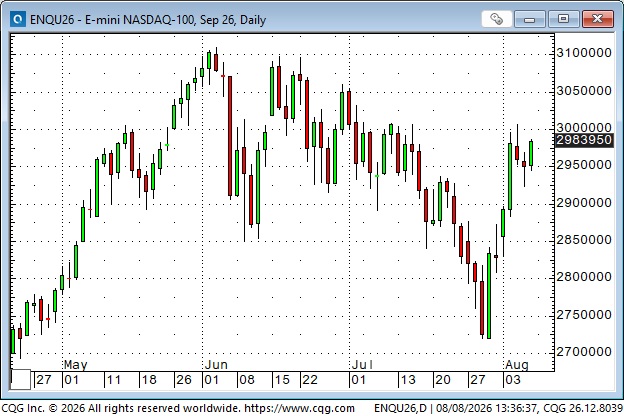
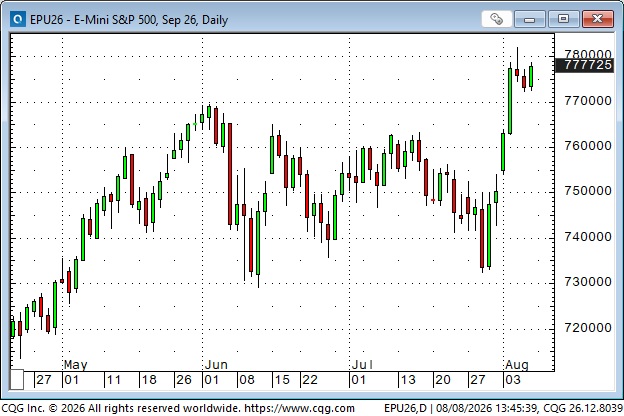
The S&P fell less than 5% from its June highs to last week’s lows, and when it pivoted higher, it rallied nearly 7% to new record highs.
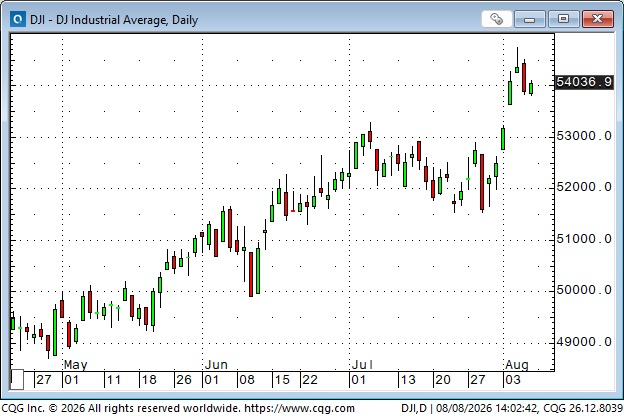
The DJIA hit a record high in early June, but slipped lower over the next couple of weeks as tech shares weakened. It fell over 1,000 points on July 29 as the S&P and NAZ tumbled, but pivoted higher the next day and gained over 3,000 points by the middle of this week, reaching a new record high.
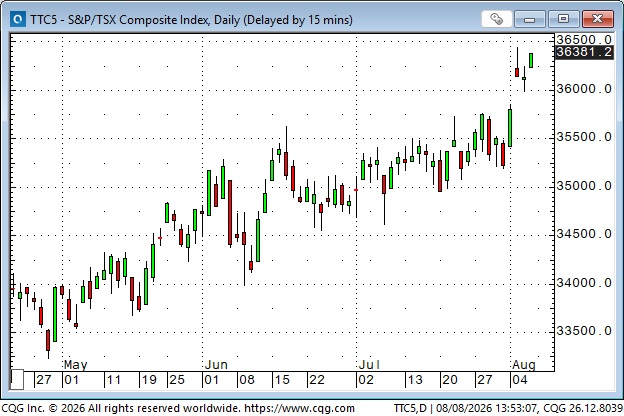
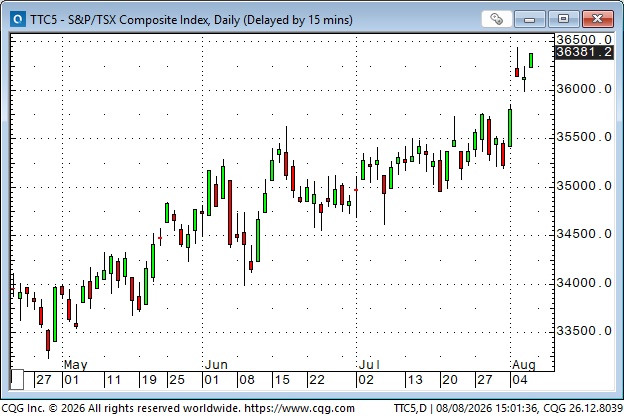
The Toronto Composite Index closed on its lows last week (after reaching record highs on Tuesday), but surged higher after the Canadian long weekend and closed this week at new record highs.
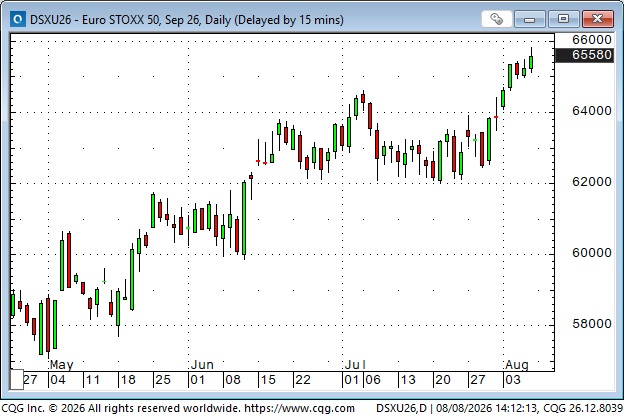
The EuroSTOXX 50 Index reached record highs in early June, drifted sideways to lower for the next couple of weeks, but then surged higher with the North American indices, closing this week at new record highs.
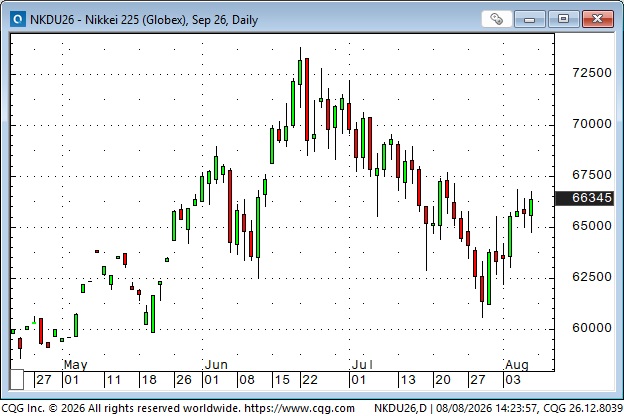
The Japanese Nikkei Index (my proxy for the North Asian markets) soared to record highs in mid-June, tumbled over the next 6 weeks, and then reversed higher last week in harmony with the key US indices.
The Magnificent Seven (MAGS) were once THE HEART of the tech rally, but were buffeted by “rotation” after hitting record highs in May; they, too, had a scorching rally from last week’s lows.
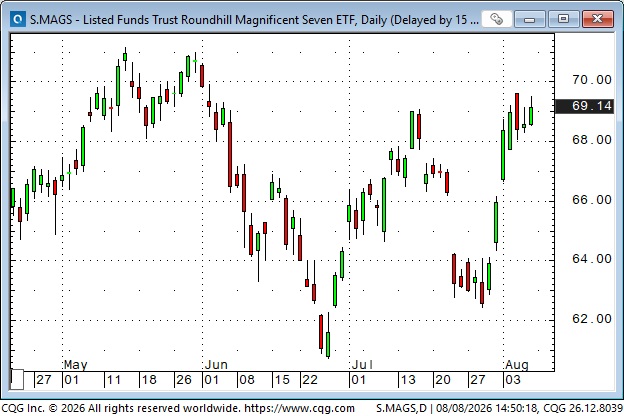
The market cap of the MAGS is ~33% of the S&P market cap, so the sharp decline of “big tech” in June dragged the S&P lower relative to the “equal weight” S&P, which continued higher throughout June and July.
I read analysts’ reports of record retail selling last week as the Nasdaq plunged for 6 consecutive days, followed by record stock option call buying on Tuesday of this week as the S&P and DJIA broke out to new all-time highs.
BoA research shows that stock market sentiment is now extremely bullish, relative to the last 20 years.
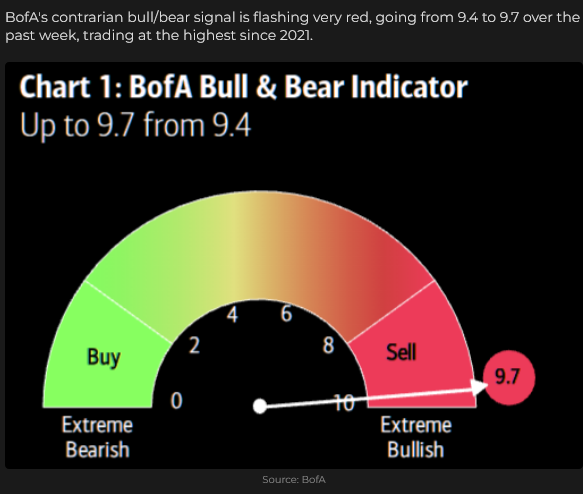
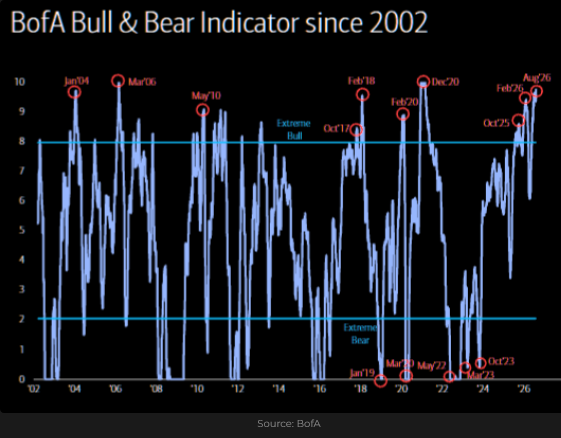
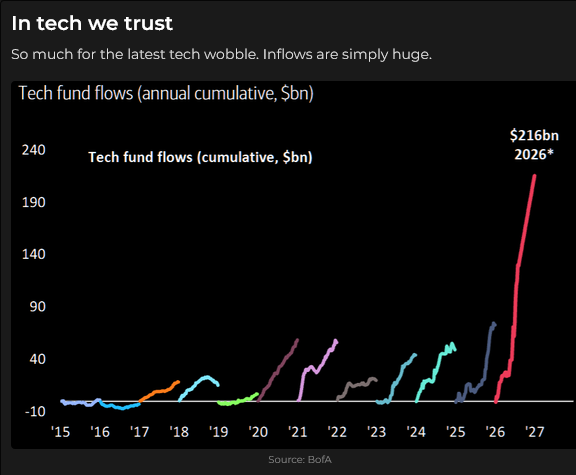
Traders/investors love tech shares more than ever.
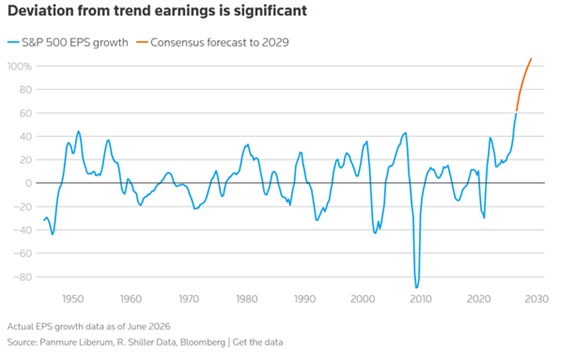
Actual earnings growth has supported the “case” for higher share prices, while forecasts for even greater earnings growth help sustain the rally.
Interest rates
The American employment data this week (especially Friday’s NFP report) downshifted the market’s expectations of Fed increases this year to ~25 bps by December.
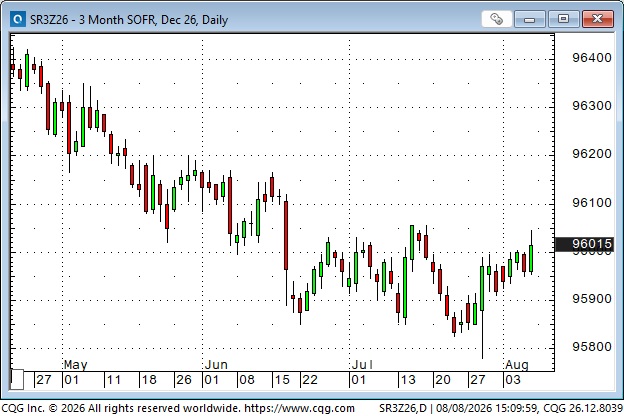
As much as I used to think of the monthly NFP report as the “granddaddy” of all economic reports, I think it has lost a lot of its former impact on markets. The CPI report on August 12 has the potential to be more “impactful” given that the market is trying to “read” Kevin Warsh, the new Fed Chairman, to determine what he will do with short rates.
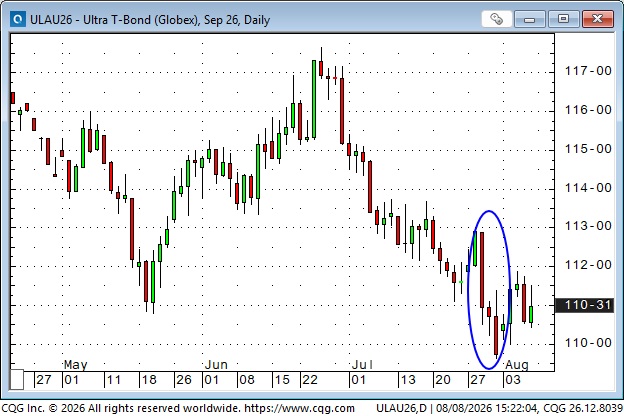
The FOMC did not raise short-term interest rates on Wednesday of last week (July 29), and the 30-year bond yield soared to 20-year highs of ~5.28% by the end of the week (blue ellipse). I think the bonds sold off on concerns over government deficits, inflation, possible foreign selling (Japan), and rising corporate issuance, and the fact that Warsh was not raising short rates to “cool” inflation was “bad news” for bonds.
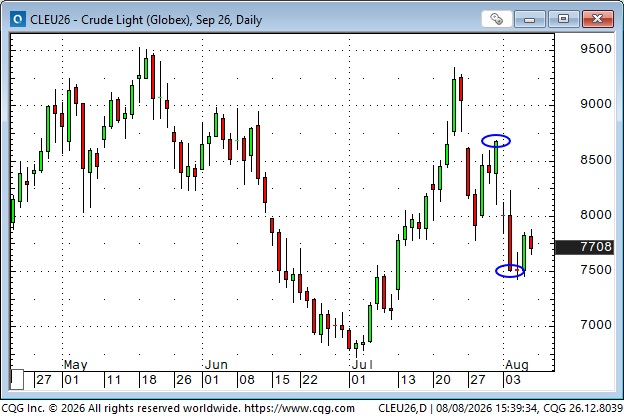
President Trump’s threat to hit Iran very hard over the weekend caused oil futures to close at their highs last Friday, and that likely added to pressure on the bonds. But Trump demurred over the weekend (to give peace a chance), and WTI dropped ~$12 from last week’s close to Tuesday’s lows, and the bonds had a modest rally off their multi-year lows. The Treasury Secretary’s quarterly refunding announcement this week contained no plan to increase bond issuance – the rising deficit will be funded at the short end of the curve.
Currencies
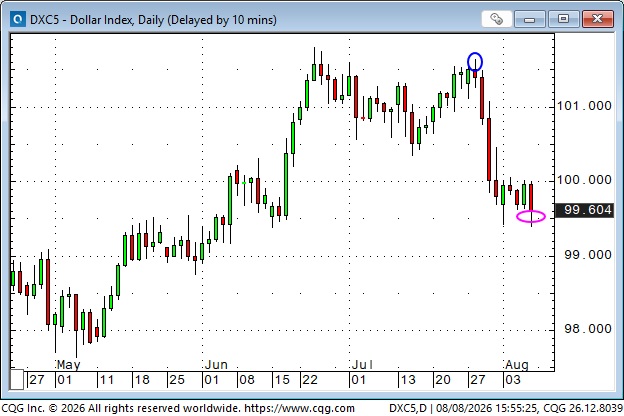
The DXY US Dollar Index reached a 14-month high in June, but has weakened ~2% since, with the Fed not raising interest rates on July 29 (blue ellipse) and weaker employment data on Friday (pink ellipse). Speculators were very close to record bullish USD positioning in the futures market, as of October 4, according to the Commitments of Traders (COT) report from the CFTC. This positioning has been building as the USDX rallied ~6% from 4-year lows reached in January.
The Japanese Yen rallied over 5% from 40-year lows reached last week on intervention efforts by both Japanese and American authorities.
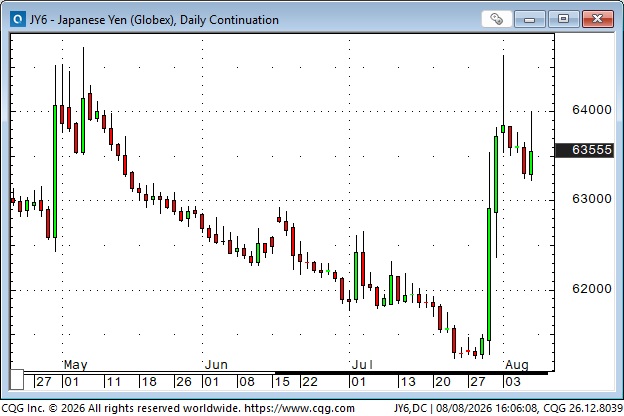
Previous intervention efforts by the Japanese authorities since 2024 have only provided a brief lift for the Yen before it dropped to new lows.
In last week’s Notes, I wrote: I have written about a possible turn higher in the Yen several times over the past year. The Yen is down over 50% from its 2011/12 record highs against the USD, but I believe once it finally turns, it will begin a multi-year rally (rising against other currencies more than it rallies against the USD). Intervention over the last few years has temporarily boosted the Yen, but has not created a “durable” low because fundamental policies in Japan need to change. The government runs a huge fiscal deficit, and the BoJ keeps bond yields artificially low. A weakening Yen has been a “pressure valve” in this environment. If the new Takaichi government can demonstrate that Japan is on a “new path” and if repatriation flows begin, then the Yen may start a self-sustaining rally. I think there’s a good chance that “the lows have been made” this week (markets are forward-looking), but “real money” accounts will be cautious and slow to move.
There has been considerable “comment” from analysts recently about whether or not the Yen intervention “will be different this time.” I recommend three analysts that I subscribe to: Michael E. Green, Robin Brooks, and Mark Farrington.
While I’m recommending links, here’s a link to a good daily FX report written by analysts at the Bank of Nova Scotia that I have read for years.
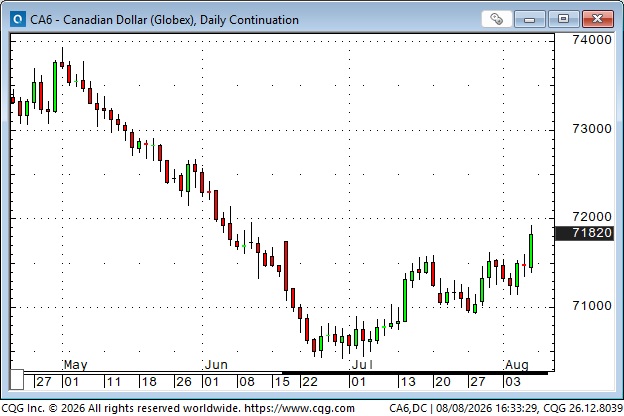
The Canadian Dollar has rallied ~1.5 cents to ~72 cents in the last month as US interest rate premiums over Canada have shrunk. Speculators began building a massive short position against the CAD in early May, and COT data shows they were near an all-time record-sized short position as of August 4. The rally over the last three days may have been driven by a combination of bullish Canadian data (Friday’s employment report), a broadly weaker USD, a shrinking US interest rate premium over Canadian rates, and short-covering.
Gold
A weaker USD and lower short-term interest rates “opened a door” for a rally in gold and silver this week. Gold is up ~$400 from the lows of the past few weeks at ~$4,400. Silver is up ~$8 to $63. Here’s a chart of December COMEX gold futures:
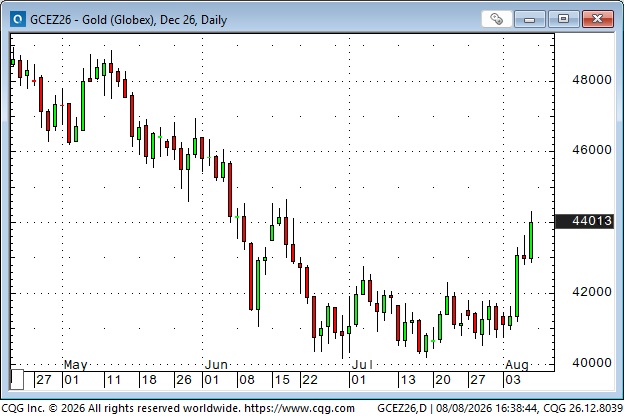
Gold soared to all-time highs of ~$5,500 in January, dropped ~$1,000 the following week, bounced back to make a lower high around $5,400 in March and then began a relentless decline to ~$4,000 in June and July. In previous Notes I’ve written that the pattern of the peak and subsequent decline looked very much like the pattern in 1980 (I was actively trading gold then), and I thought the decline was likely the result of selling by over-leveraged speculators reducing their positions (voluntarily or otherwise).
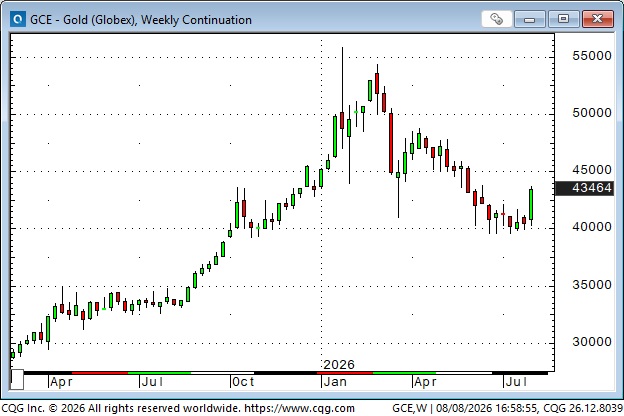
Recently (July 18 Notes), I noted: there seems to be support below $4,000. Central bank buying has increased recently, and speculative stop-loss selling seems to have run its course (in futures, if not in ETFs).
My friend, Kevin Muir, The Macrotourist on Substack, published a piece yesterday explaining why he is now buying gold and gold mining shares. I subscribe to Kevin’s Substack, so I can’t tell if his piece on gold is behind a paywall.
I recommend Ross Norman’s metalsdaily.com site for daily metals commentary.
I subscribe to John Johnston (JJ) Market Vibes on Substack. He has great insights into metals and energy and is a veteran floor trader.
Energy
I look/subscribe to several different websites for energy market commentary, including: https://oilprice.com/, Josef Schachter, Riko Kardamow, and Tracy Shuchart.
Thoughts on Trading
One of the people I subscribe to on Substack is Stephen Innes. He’s a Canadian veteran trader/analyst living in Thailand, and I’m constantly amazed at the volume of content he produces and the high quality of his service. He’s equally at home writing about equities, credit, currencies, metals or energy.
From time to time, he writes a piece that is similar to my “Thought on Trading.” Here’s a link to his latest “Trader” piece: When Traders Do Really Dumb Things
My short-term trading
I bought the Canadian Dollar early this week and held the position into the weekend.
I shorted the S&P on Thursday after it dropped back from all-time highs on Tuesday. I covered the trade for a wash ahead of Friday’s employment report.
One more recommendation
I downloaded Brent Donnelly’s new book, “Trade Outside The Box,” from Amazon when it was released in June, and finished reading it last week. (I read a little every night before I fall asleep). Brent is another Canadian veteran trader working outside Canada. He lives in New York, and I highly recommend his book to experienced traders. People who are “new to the game” might want to read his Alpha Trader book first.
Here’s the week ahead calendar from Brent Donnelly:
The Barney report
Here’s Barney doing his impression of “Upside Down Dog.”

Listen to Mike Campbell and me discuss markets
On today’s Moneytalks show, Mike and I discussed the dramatic sell-off and rebound in the equity markets over the last two weeks. We also touched on FX, energy and gold. You can listen to the entire show here. My spot with Mike starts around the 1-hour, 8-minute mark. Don’t miss his interview with Terry Glavin, starting around the 5-minute mark.
Listen to Jim Goddard and me discuss markets
On my monthly 30-minute interview on This Week In Money with Jim, we talked about equities, currencies, gold, interest rates and oil. Jim also asked me how I delt with losing money trading in July. You can listen to the interview here: my spot with Jim starts around the 30-minute mark.

The Archive
Readers can access any of the weekly Trading Desk Notes from the past six years by clicking here.
Subscribe: You have free access to everything on this site. Subscribers receive an email alert when I post new content, typically four to six times a month.
Victor Adair retired from the Canadian brokerage business in 2020 after 44 years and is no longer licensed to provide investment advice. Nothing on this website is investment advice for anyone about anything.
STAY INFORMED! Receive our Weekly Recap of thought provoking articles, podcasts, and radio delivered to your inbox for FREE! Sign up here for the HoweStreet.com Weekly Recap.
Victor Adair August 8th, 2026
Posted In: Victor Adair Blog
Next: