

ALWAYS CONSULT YOUR INVESTMENT PROFESSIONAL BEFORE MAKING ANY INVESTMENT DECISION

July 11, 2026 | Trading Desk Notes for July 11, 2026


Victor Adair


Investment boom in America
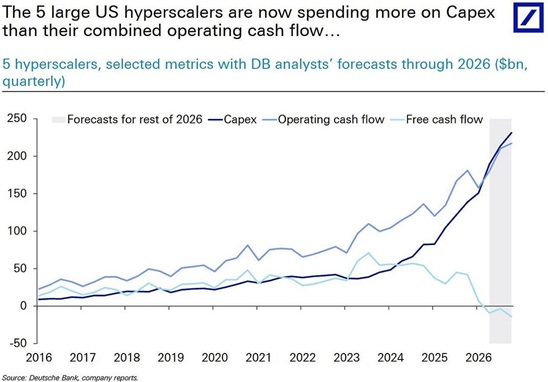
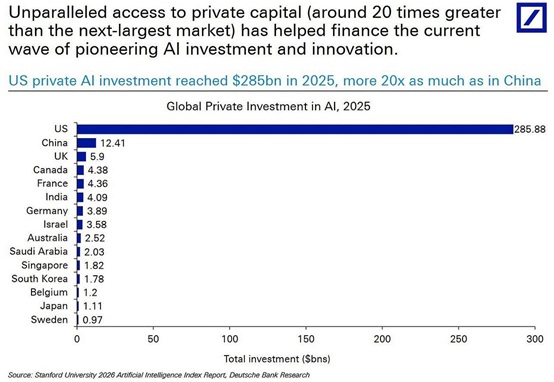
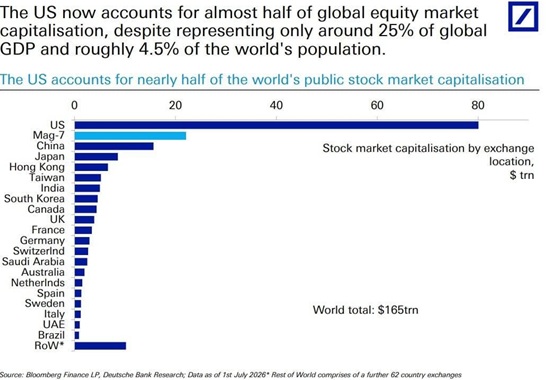
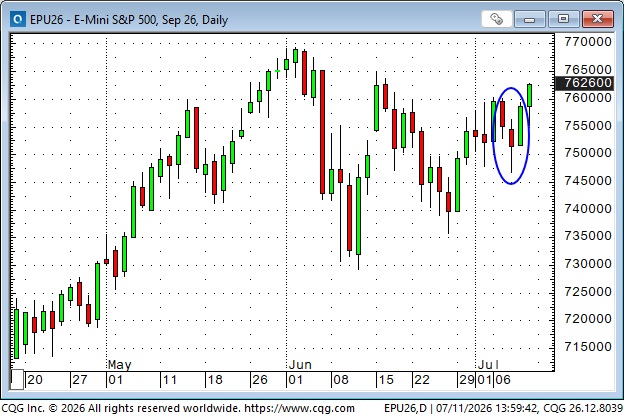
The AI capex boom is spreading throughout the economy, lifting many ships and is mildly inflationary. Stock indices, valuation metrics, earnings, and earnings expectations are near record highs, and the Q2 reporting season starts this week.
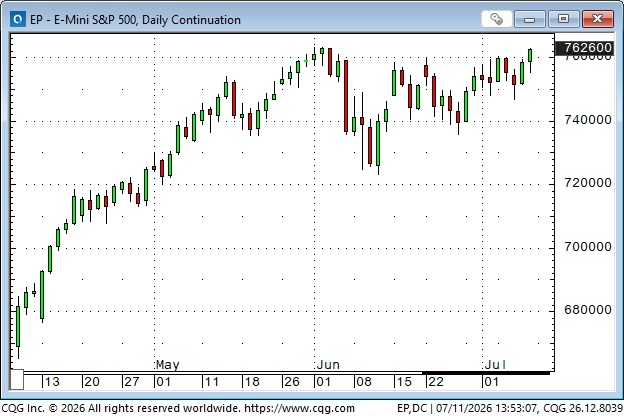
Equity markets dipped on Tuesday and Wednesday as “hostilities” flared in the SOH, but once again, the dip was a buying opportunity, and the market roared back on Thursday and Friday, closing the week at the highs.
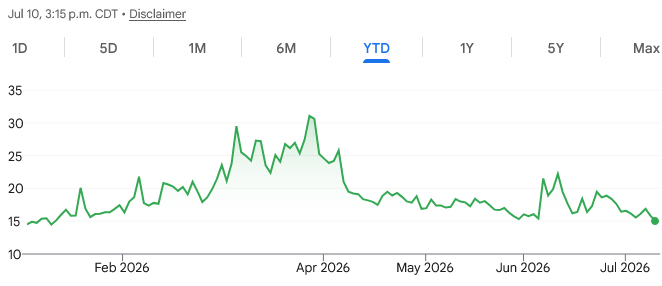
Stock Index VOL is at YTD lows, while wicked rotation is creating much higher single-stock and sector VOL. This chart is the CBOE VIX. Alpha has come from being right on rotation, not from trend following.
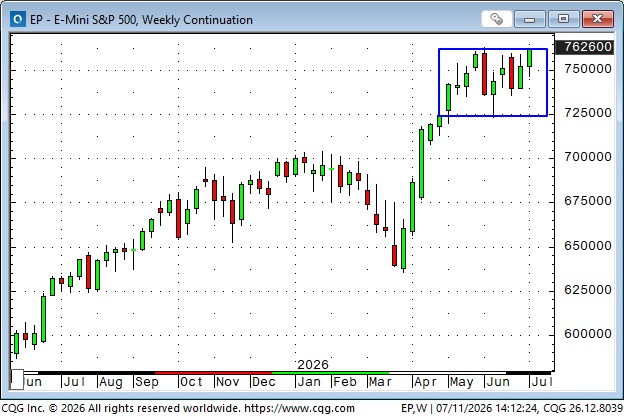
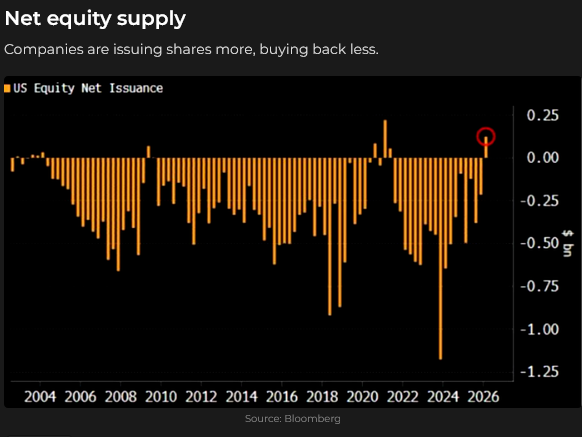
High stock prices are causing lots of “supply” (IPOs, etc.) to come to market (SpaceX, SK Hynix ADRs, etc.), with lots more to come, but the market is absorbing it, and the S&P has trended sideways to higher over the last 10 weeks, near record highs.
There’s an old saying in markets that “high prices are the best cure for high prices” because, one way or another, high prices will create “new supply.”
It seems that equity markets have “learned” to fade war escalation worries, that “dips” created by hostilities, or the threat of hostilities, are simply buying opportunities. With leverage in the equity markets at record highs, volatility would likely spike if people bought the next “hostility dip” and the market kept falling.
Energy
Front-month WTI crude oil futures spiked to ~$120 in early March (a 4-year high), but returned to pre-war levels last week.
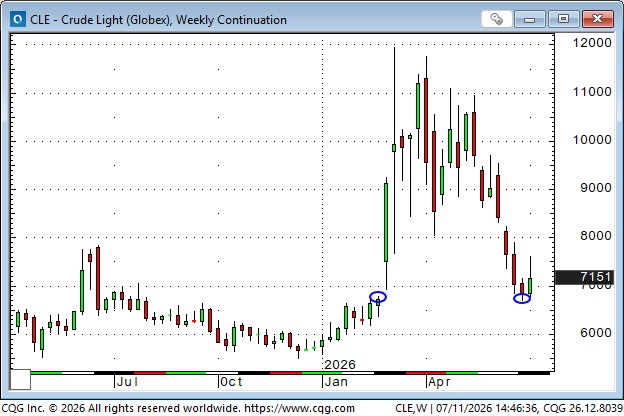
August WTI spiked ~$9 from last week’s low to this week’s high on Tuesday/Wednesday as the US and Iran exchanged fire (and Trump declared the ceasefire over). Prices dropped back, closing the week at ~$71 as tensions eased.
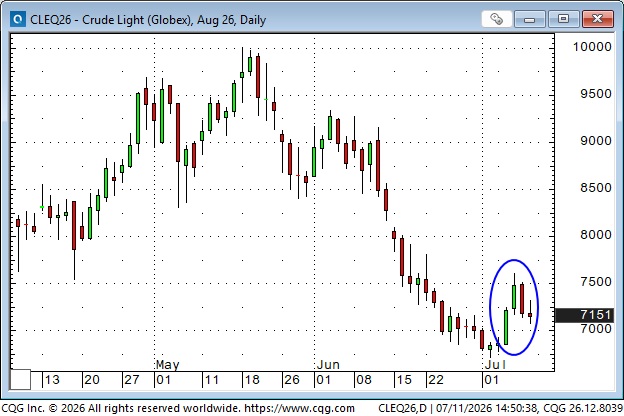
On Friday night, Trump gave Iran 24 hours to agree that the SOH would be open and free of charge. Negotiations are apparently underway in Oman. Trump has also told Iran that “standing orders” are in place to destroy their country if he is assassinated.
There’s no shortage of crude oil, but there is a shortage of refinery capacity, which has created a shortage of products like gasoline, diesel and jet fuel.
For details on the shortages, I highly recommend a terrific Substack article by Kardamow. Here’s a comment I posted on his Substack:
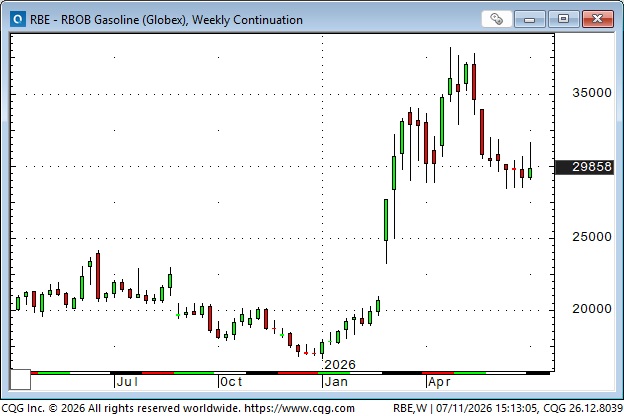
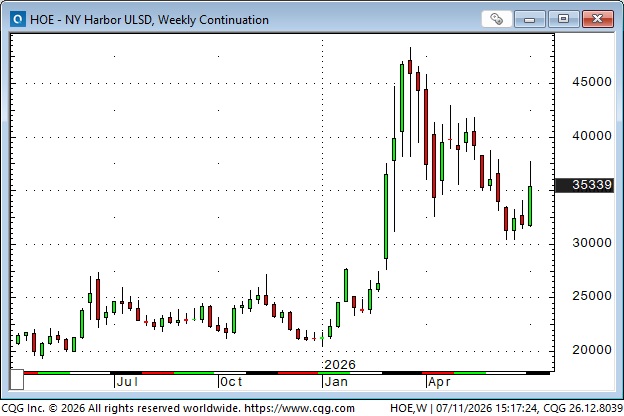
Riko: So we’re short on refining capacity and product storage, and the existing refineries are running flat out, which may cause a breakdown. I’m relearning why my friend JJ (Alyosha on Substack) says a barrel of crude is worthless until it reaches a refinery. I’ve watched the crack spreads and the refining company share prices, and it’s easy to see that RBE and HOE haven’t fallen back from the April highs nearly as much as WTI. Now, when does hurricane season start in the Gulf?
Here’s a chart of RBE gasoline futures. Prices have given back only ~50% of the jump from pre-war levels to the April highs. American refineries are exporting record quantities of gasoline, diesel and jet fuel as global refining capacity is impaired.
The chart of HOE heating oil futures (essentially untaxed diesel) is similar to the RBE chart.
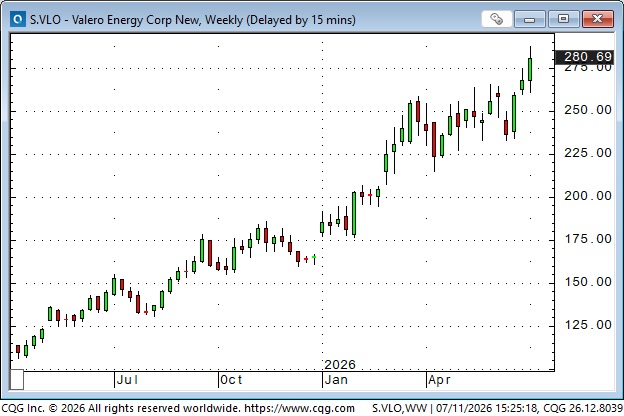
This chart is the share price of Valero Energy, a leading US refinery. US refinery margins (profits) are at record highs.
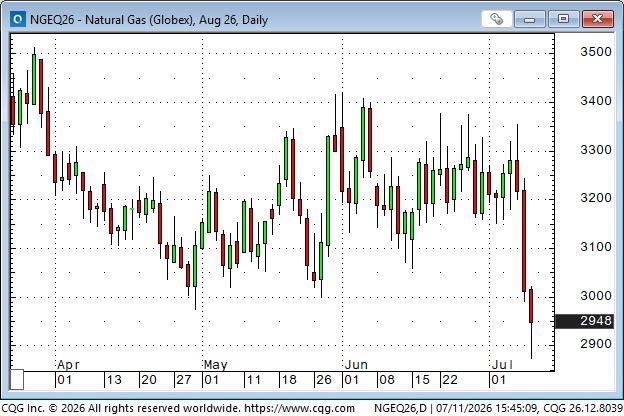
August NYMEX natural gas futures fell to life-of-contract lows this week as robust domestic production led to a dramatic expansion in storage inventories and as Freeport LNG went offline for unplanned maintenance, reducing exports. (Prices on continuous charts of front-month LNG fell to a 2-month low. Natgas prices are subject to significant seasonal demand fluctuations.)
Currencies
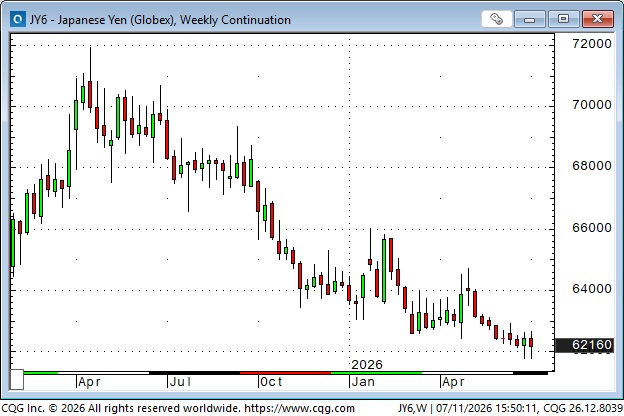
The Japanese Yen traded at a 40-year low against the USD this week, and it is near record lows against the Euro and many other currencies. The new Japanese federal government is trying to energize the economy. If the market thinks that will happen, then capital flow to “bargain-priced” Japan would likely cause the Yen to rally. Japan has ~US$ 5 trillion in foreign investments, and if some of that capital is “repatriated” to Japan, it would likely cause the Yen to rally and might also attract foreign capital to Japan.
Here’s a comment I posted on Mark Farrington’s Substack after reading his excellent article early this week on the current status of the Yen:
Thanks, Mark. I always enjoy reading your posts. From a trader’s perspective, I think the Yen will rally from 40-year lows once the market believes that the Japanese authorities (finally) recognize that a weak Yen leads to an even weaker Yen, which is definitely not in Japan’s best interests, and they do whatever is necessary to halt the decline. In terms of timing, and in harmony with your thoughts on timing, I don’t think we’re there yet, but we’re close. Once “the bottom is in,” I expect the Yen will rally more against other currencies than against the USD.
On Thursday night (North American time), the Japanese Finance Minister, Katayama, suggested that the massive Government Investment Pension Fund (~US$ 1.8 trillion in total assets) should consider selling some of its overseas investments and bringing the proceeds back to Japan to invest in Japanese economic growth. The Yen jumped on her speech.
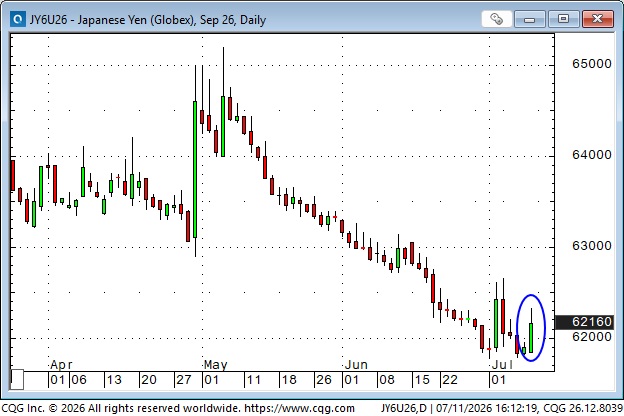
I believe this comment from the Finance Minister may be a “game-changer” for the Yen. I understand there are several “very good reasons” why the Yen is at 40-year lows, and I may be wrong on timing, but I think things are “turning around” in Japan and, if so, the Yen could rally. For a very thoughtful essay on “why,” check out this Substack post from Stephen Innes.
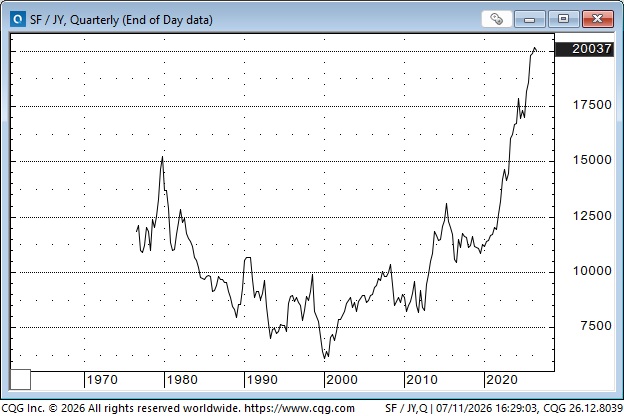
Brent Donnelly also commented on the Yen and suggested that people who don’t like the “carry” risk on the Yen (with Japanese short-term interest rates much lower than American rates, the forward FX market prices the Yen at a substantial premium to the spot market) should consider selling CHFJPY or buying put spreads on CHFJPY. His reasoning is that Swiss short rates are even lower than Japanese rates, so there is little “carry” risk.
This chart shows that the Swiss Franc is at record highs against the Yen.
Thoughts on trading
When I started this website 6 years ago, I anticipated writing separate articles on The Trading Life and Trading Principles, as well as the weekly TD Notes. But time was always short, so the best I could do was add some extra comments (like this one) to the weekly Trading Desk Notes.
I’ve had the pleasure of knowing some very successful traders, and, of course, I’ve read about many others (Jack Schwager’s Market Wizards series is amazing).
If there is one thing all successful traders have in common (and this may be the ONLY thing they have in common), it is that they have found a way to participate in markets that suits them. My guess is that it takes years to “find your own way,” and that as markets change and as you change, your way of trading has to change too.
Another observation I have about successful traders is that they aren’t much better at “predicting the future” than anybody else, but they have an “uncanny” ability to manage risk better than most other traders.
Which leads me to this question, which I think all successful traders will agree is one of the most important for traders to answer: “What are you going to do if you’re wrong?”
Every trader is wrong sometimes. Many successful traders lose money on half of their trades. Many successful traders will tell you that nearly all of their net profits come from fewer than 20% of their trades.
There’s nothing wrong with being wrong, except staying wrong.
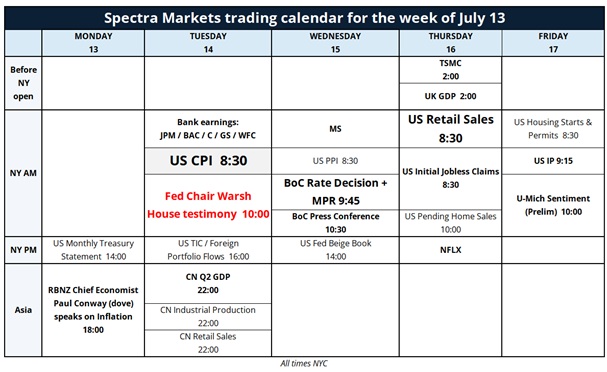
The calendar for this coming week – thanks, Brent Donnelly
My short-term trading
I started this week short the S&P, long the Yen and long Natural Gas.
The S&P traded sideways in the Sunday evening session after the long weekend, then started to rally in the Monday day session, so I covered my short for a slight loss. I reshorted the S&P in the Monday evening session and was over 100 points ahead on the trade at Wednesday’s lows (SOH hostilities). I covered for a gain of ~80 points as the market began to rally from the lows.
I covered my long natgas position on Wednesday for a breakeven when it reversed from 6-day highs. I was glad I had covered when it tumbled nearly 40 cents to Friday’s lows.
I added to my long Yen trade on Friday after reading the Finance Minister’s comments. The only position I held into the weekend was my long Yen trade.
The Barney report
It’s been a wonderful summer here on Vancouver Island, and Barney and I are out walking at least three times a day. The abandoned railway track in the forest near our house is our most regular walkway because it’s handy and I can allow Barney to run off-leash there. He loves it!

Listen to Mike Campbell and me discuss markets
On this morning’s Moneytalks show, Mike and I discussed the equity markets, shortages in energy markets, and the Japanese Yen. You can listen to the entire show here. My spot with Mike starts around the 45-minute mark.
Listen to Jim Goddard and me discuss markets
I did my monthly 30-minute interview with Jim on the This Week In Money show this morning. We discussed the equity market’s “limited” reaction to the SOH hostilities, the crude oil and products market, currency markets, and gold, as well as why I limit my trading to financial futures and options. You can listen to the entire show here. My spot with Jim starts around the 9-minute mark. My good friends Ross Clark and Josef Schachter are also on the podcast.

The Archive
Readers can access any of the weekly Trading Desk Notes from the past six years by clicking here.
Subscribe: You have free access to everything on this site. Subscribers receive an email alert when I post new content, typically four to six times a month.
Victor Adair retired from the Canadian brokerage business in 2020 after 44 years and is no longer licensed to provide investment advice. Nothing on this website is investment advice for anyone about anything.
STAY INFORMED! Receive our Weekly Recap of thought provoking articles, podcasts, and radio delivered to your inbox for FREE! Sign up here for the HoweStreet.com Weekly Recap.
Victor Adair July 11th, 2026
Posted In: Victor Adair Blog
Next: Economic Anomalies »