
ALWAYS CONSULT YOUR INVESTMENT PROFESSIONAL BEFORE MAKING ANY INVESTMENT DECISION

January 4, 2026 | Why Did Trump Really Take Venezuela? It Wasn’t Just Oil!

Martin Armstrong


COMMENT: You said these podcasts that Venezuela had the oil but the big question is China. Would like to expand on that now? Socrates showed the dollar taking off in October 2024 and the fourth quarter was a turning point. But it now shows volatility rising from February on. It looks like this is not over as you say until the fat lady sings.
FDS
ANSWER: OK. I suppose I can now give the bigger picture that headlines miss. Trump’s comment throws in energy secondly. He does not mention drugs. Most of the drugs come in through Mexico. As I have said, China is the #1 client of Venezuela. This all depends on the takover of those oil assets by the American oil companies and do they cut off China. That may not be in the cards just yet because Venezuela owes a lot of monet to China. However, overlooked here is the connection to Russia. That is the real issue nobody is taking about and this has been a goal of Rubio for a very long time.
Russian lawmaker Alexei Zhuravlyov told Gazeta.ru on November 1st, 2025 that Russia MAY supply Venezuela with its new Oreshnik and Kalibr missiles, stating “I see no obstacles to providing our friendly nation with new systems such as the Oreshnik or the well-proven Kalibr missiles.” This wasn’t merely hypothetical posturing but a direct response to U.S. military buildup in the Caribbean. This threat was taken seriously. The Oreshnik, with a reported maximum range of about 3,400 miles, could theoretically threaten much of the continental United States as well as Puerto Rico. The Kalibr is thought to have a range of between 930 and 1,550 miles, which could possibly threaten the southern continental U.S., as well as facilities throughout the Caribbean.
From Venezuelan territory, the missile could target most of South America, the Caribbean, Mexico, and large portions of the United States—with Washington likely among its primary targets, given the tense relations between the US and Maduro’s regime. Even parts of Canada could fall within its range.
The relationship between Venezuela and Russia and China represented one of the most significant geopolitical realignments of the 21st century, built on anti-American sentiment, oil-for-loans arrangements, and mutual opposition to U.S. hegemony. This trilateral dynamic evolved from modest beginnings under Hugo Chávez into a comprehensive strategic partnership that has sustained the Maduro regime through economic collapse and international isolation.
The relationship between China and Venezuela took formal shape in 2006, under President Hugo Chávez, with Caracas signing several trade agreements with Beijing and describing China as a “Great Wall” against US influence. Chávez, seeking to diversify Venezuela’s oil exports away from the United States and counter American regional dominance, found in China an eager partner with rapidly growing energy needs and no political conditions attached to its financing.
The financial dimensions proved staggering. China began extending large loans to Venezuela, backed by future oil supplies of oil. In 2006, Beijing provided $2 billion in loans, which rose to $7 billion in 2007. Of the $150 billion the Chinese Development Bank loaned to Latin America in the past 12 years, a third went to Venezuela. These weren’t traditional loans but rather oil-collateralized arrangements where Venezuela repaid through petroleum shipments to Chinese state companies.
In 2007, China and Venezuela set up a joint fund worth $6 billion–$4 billion loan from the China Development Bank (CDB) and $2 billion from El Fondo De Desarrollo Nacional S.A. (FONDEN) set up by Caracas. This fund doubled to $12 billion by 2009. The mechanism was straightforward: China provided upfront capital, and Venezuela committed to shipping specified quantities of oil at predetermined prices. When oil prices collapsed in 2014 and Venezuela’s economy imploded, China extended additional lifelines including a $10 billion loan to support the country’s balance of payments.
The relationship peaked between 2010 and 2013, when Venezuela received approximately 64% of China’s new credit lines to Latin America. However, as Maduro’s mismanagement destroyed the oil industry and production plummeted, Chinese enthusiasm collapsed as a result. By 2016, Venezuela received only 10% of Chinese regional lending, and new financing essentially ceased. China focused instead on restructuring existing debt and protecting already-committed investments.
China is owed by Venezuela at least $20 billion in loans established before 2017. Some estimate that is even higher. The relationship shifted from expansion to damage control. Maduro’s rampant corruption and mismanagement has led to the region’s worst economic depression, creating unfavorable investment conditions, affecting oil production and exports, and limiting return on Chinese investment and Venezuela’s ability to repay Chinese loans.
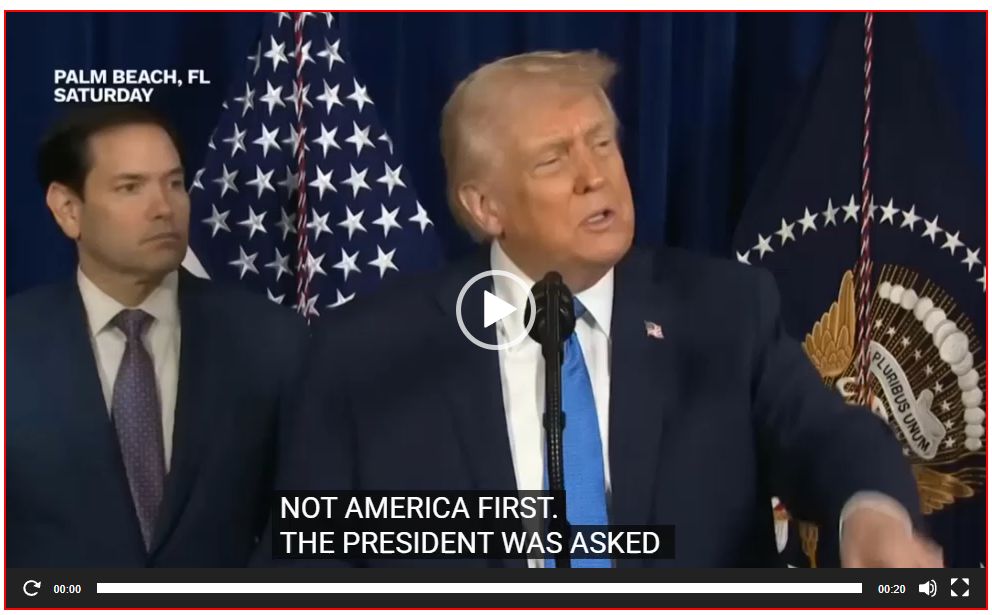
Now, that said, we must look at the Russian comment and look at this video. Who is standing there with Trump? Marco Rubio. If you remember, Rubio was also running for president against Trump in 2016. Who was funding his campaign? Goldman Sachs. Rubio has pushed for regime change in Venezuela because of Russia for years. Marco Rubio has held many titles during Donald Trump’s presidency, and he now adds another: Viceroy of Venezuela.
Russia’s engagement with Venezuela followed different patterns than China’s, emphasizing military cooperation alongside energy sector involvement since Russia did not need their oil. Where China provided infrastructure loans, Russia sold weapons systems. From 2005, Venezuela purchased more than $4 billion worth of arms from Russia. These sales included fighter aircraft, helicopters, armored vehicles, and air defense systems, transforming Venezuela’s military from American-equipped forces to Russian-supplied ones.
Russia and Venezuela forged a comprehensive strategic partnership centered on anti-hegemonic solidarity and pragmatic cooperation. This wasn’t merely commercial but explicitly geopolitical. Chávez and later Maduro positioned Venezuela as Russia’s foothold in the Western Hemisphere, allowing military exercises and bomber flights that signaled Moscow’s reach into America’s traditional sphere of influence.
The energy relationship proved more complex than China’s. Russia’s state oil company Rosneft provided billions in loans and took equity stakes in Venezuelan projects, though on smaller scale than Chinese financing. Russia’s state-backed oil company Rosneft loaned $2.3 billion, excluding interest. Critically, Russia helped Venezuela circumvent U.S. sanctions by facilitating oil exports through complex shipping arrangements and providing technical expertise to maintain declining production.
The trade balance between Moscow and Caracas increased by 64% in 2024, demonstrating sustained engagement despite Venezuela’s economic deterioration. Russia viewed Venezuela through multiple lenses simultaneously both as an economic opportunity, as well as a strategic geopolitical asset.
The Geopolitical Chess Move

Listen to Podcast:
STAY INFORMED! Receive our Weekly Recap of thought provoking articles, podcasts, and radio delivered to your inbox for FREE! Sign up here for the HoweStreet.com Weekly Recap.
Martin Armstrong January 4th, 2026
Posted In: Armstrong Economics
Next: 2026: The Year to Be Optimistic »